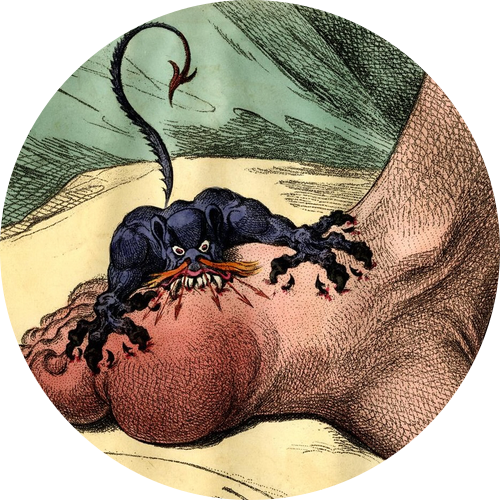
Why gout gets worse before it gets better
You start treatment for gout. A few weeks in, you have an attack. Then another. The tablets were supposed to fix this, and instead the worst months you have had are the ones since you started.
This is where most people quit. It is also, almost always, the point at which the treatment is working.
The clearest explanation of this is not in a patient leaflet. It is a two-page editorial in the International Journal of Rheumatic Diseases, written by a doctor at a gout clinic in Osaka and a colleague at Kobe University who were tired of watching patients stop treatment for exactly this reason. They drew the whole disease as snow on a roof.
Here is that idea, redrawn.
1. The snowfall
Hyperuricemia is snowfall. A high urate level is not the damage — it is the rate at which the damage accumulates.
Uric acid dissolves in your blood and joint fluid only up to a point. Above roughly 7.0 mg/dL it stops staying dissolved and starts forming monosodium urate crystals on the lining of your joints: a thin, growing layer.
In the analogy, a high urate level is snowfall. The joint lining is a roof. The crystal layer is snow settling on it.
Two things follow straight away. Snowfall is not the same as snow cover — your reading today tells you how fast the layer is growing, not how much is already up there. And the layer builds in silence. Nothing hurts while it is snowing.
2. The avalanche
The attack is not your urate level. It is a slab of crystal coming loose.
Eventually the layer on the roof becomes unstable, and a slab of it breaks free and falls into the joint cavity below. Rheumatologists call this crystal shedding.
That is the attack. Your immune system does not react to dissolved urate — it reacts to loose crystals suddenly floating in the joint. Macrophages and neutrophils read needle-shaped crystals as an invader and respond violently. That response is the swelling, the heat, the pain.
Which explains the thing that confuses nearly everyone: attacks do not track your current reading. You can have an attack with a perfectly normal urate level, and you can sit well above the limit — 10.0 mg/dL — and have none. Avalanches are about what is on the roof and whether it is stable, not about whether it happens to be snowing this morning.
3. Why the roof stays dangerous
The most avalanche-prone stretch is the one right after an attack — and right after treatment starts.
Here is the part that costs people their treatment.
For about a month after an attack, what remains on the lining is at its least stable. The slab that fell has left a broken edge, and what is left of the layer breaks away easily. On top of that, when treatment starts pulling your urate down, deposits begin loosening from the surface as they dissolve.
So the first months of treatment are, mechanically, the most avalanche-prone stretch you will have. If the level is pulled down too abruptly, the editorial’s authors note that the instability can drag on for two to three months or more.
Judged by symptoms, this looks exactly like the treatment making things worse. Judged by the mechanism, it is what melting looks like from underneath.
This is why the 2020 American College of Rheumatology guideline makes two strong recommendations that are easy to mistake for timidity. It recommends starting allopurinol at a low dose — under 100 mg a day, and lower again in kidney disease — then titrating upward, explicitly because “a lower starting dose of any ULT reduces the risk of flare associated with initiation.” And it strongly recommends anti-inflammatory cover alongside it, continued for three to six months rather than under three.
The flares are anticipated. They are budgeted for in the guideline. They are not evidence that something has gone wrong.
4. Melting it slowly
Held below target, the layer dissolves from the surface — gradually enough that nothing sheds.
Hold the urate level below the point where crystals stay solid and the layer dissolves. Slowly, from the surface, without a slab coming off.
If the solubility limit is around 7.0 mg/dL, why is the treatment target under 6.0 mg/dL? Margin. At 6.9 mg/dL you have stopped adding snow, but you have not meaningfully started melting it. Below 6.0 mg/dL the gradient is steep enough that deposits actually shrink, and the level stays under the limit through the ordinary swings of a normal day.
“For all patients taking ULT, we strongly recommend continuing ULT to achieve and maintain an SU target of <6.0 mg/dL over no target.” That one is graded strong, on high-certainty evidence — the top of both scales the guideline uses. Nearly everything else in gout treatment is downstream of it.
5. The bare roof
No layer, no slab, no attack. This is the end state the treatment aims at — and it is reachable.
When the deposits are gone, there is nothing left to shed. No slab, no avalanche, no attack.
That is not remission in the sense of managed. The crystals are physically gone. In a Spanish study, 18 people with crystal-proven gout had fluid drawn from a quiet joint every three months after their urate was brought down to normal. The crystals disappeared from every single one of the 18 joints.
So how long does the melt take?
That study is also the best answer anyone has to the question people actually want answered. Time to the crystals disappearing ranged from 3 to 33 months, and it correlated with how long the person had had gout. The deeper the snow, the longer the melt.
A separate study of 63 people with tophi found the rate of shrinkage was linearly related to the average urate level achieved during treatment: the lower it was held, the faster the deposits went. There is no threshold you cross and then coast. How fast it melts depends on how far below the line you keep it, and for how long.
Which reframes the whole first year. The question is not am I still getting flares? It is has my level been under target every time it has been checked?
What the analogy actually changes
Three things, if you take it seriously.
Your urate number is the treatment; the flares are weather. In the months after starting, symptoms and progress point in opposite directions. The only readout that means anything is the number — and a single reading is not a trend. You need the sequence.
The clock runs on months at target, not months on tablets. A year spent at 6.5 mg/dL is not a year of melting. It is a year of not much happening, and it will not feel any different from the inside than a year that was working.
Nothing on the food list turns the sun on. The ACR guideline’s own evidence review found the effect of individual foods on urate to be small — a unit of beer raises serum urate by about 0.16 mg/dL. Dietary change adjusts how hard it is snowing, slightly. It does nothing at all to what is already on the roof.
If your treatment looks like it is failing in month two, that is precisely the shape the mechanism predicts. It is worth going to your doctor with what your levels have actually done over time, rather than with a description of how the last few weeks have felt — the low starting dose, the titration and the anti-inflammatory cover in the guideline all exist for exactly this stretch.
The Gout Journal app is built for exactly this: record each uric acid result, see how the measurements change over time, and monitor whether the trend is moving towards — and staying below — your target. You can view the same history in mg/dL, mmol/L or µmol/L, ready to review with your doctor instead of reconstructed from memory.
Sources
- Slowly melting the urate snow in joints: Explaining gout attacks to patients — International Journal of Rheumatic Diseases (2021)
- 2020 American College of Rheumatology Guideline for the Management of Gout — Arthritis Care & Research (2020)
- Time required for disappearance of urate crystals from synovial fluid after successful hypouricaemic treatment relates to the duration of gout — Annals of the Rheumatic Diseases (2007)
- Effect of urate-lowering therapy on the velocity of size reduction of tophi in chronic gout — Arthritis & Rheumatism (2002)
Gout Journal is written by someone who lives with gout, not by a clinician. This article is general information, not medical advice — never start, stop or change a medication without talking to your own doctor.