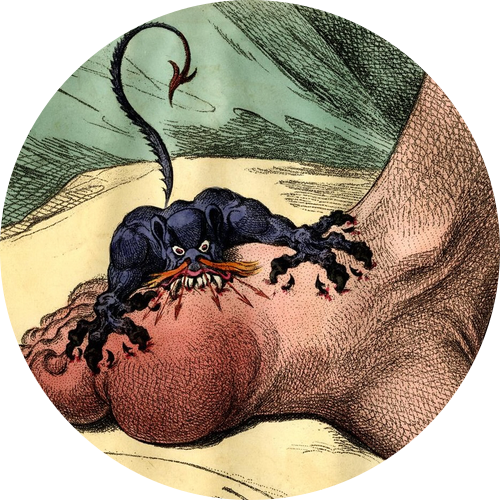
Gout is not a punishment for what you ate
Almost everyone with gout has had the conversation. You mention the diagnosis, and someone — sometimes a colleague, sometimes a relative, occasionally a doctor — glances at your plate.
The belief underneath that glance is that gout is a rich man’s disease: that your uric acid level is a readout of your appetites, and that the way back is to eat less of what you enjoy.
It is worth knowing how thoroughly the evidence has failed to support this.
The study that put a number on it
In 2018 a group of researchers in New Zealand and the United States did the obvious experiment that somehow nobody had done properly. They took 16,760 people of European ancestry from five American population cohorts — everyone without kidney disease, without gout, and not taking any urate-lowering medication — and asked a simple question: of all the variation in people’s uric acid levels, how much can diet account for?
They tested individual foods. They tested whole dietary patterns: the DASH diet, the Mediterranean diet, a healthy-eating score, and a data-driven pattern built from the cohort itself. Then they compared the answer to what common genetic variants explained in the same people.
The results were not close.
| What was measured | Variation in uric acid it explained |
|---|---|
| DASH diet score | 0.28% |
| Healthy-eating score | 0.15% |
| Data-driven dietary pattern | 0.16% |
| Mediterranean diet score | 0.06% |
| Common genetic variants | 23.9% |
Every dietary pattern they tested explained less than a third of one percent. The genome explained roughly a hundred times more.
The individual foods behaved the way you would expect — beer, spirits, wine, potatoes, poultry, soft drinks and red meat went with higher urate; eggs, peanuts, cheese, skim milk, brown bread and non-citrus fruit went with lower. The associations were real. They were just very, very small.
The 2020 American College of Rheumatology guideline, reviewing the same evidence, puts a figure on how small: a unit of beer raises serum urate by about 0.16 mg/dL. The effect of a Mediterranean or DASH diet was smaller still.
Why the effect is so small
To see why, it helps to stop thinking about urate as something you consume and start thinking about it as a level in a tank.
Your urate level is a balance, not a total. Two sources fill the tank and two routes empty it. What matters is the level, not how much has passed through.
Uric acid is what is left when your body finishes breaking down purines — and most purines never came from a meal. They come from your own cells: dying, being recycled, having their DNA and RNA dismantled. That happens continuously, in enormous quantity, whatever you eat. Food purines are a genuine but secondary contribution on top of a large baseline you cannot see and do not control.
The other side of the tank matters more. About two-thirds of your uric acid leaves through your kidneys and the remaining third through your gut. The kidney route is not a simple drain: urate is filtered out and then almost all of it is deliberately pulled back in, by a set of transporter proteins in the kidney tubule. Your level is set by how those transporters are tuned.
And they are tuned largely by inheritance. That is what the 23.9% figure is measuring — variants in genes like SLC2A9 and ABCG2, which code for the transporters that decide how much urate you reclaim rather than release.
Which is why the tap is the wrong thing to look at
In roughly 90% of people with a high urate level, the problem is excretion, not intake. Same taps. Narrower drain. Higher level.
Estimates vary, but reviews of the physiology consistently put the figure around 90%: in the large majority of people with hyperuricemia, the level is high because the kidneys are letting less go, not because the body is making more.
This is the part that reframes everything. If your drain is narrower than average, your level sits higher than average on an ordinary diet — and it will keep sitting higher on a careful one.
This is what dietary restriction does. It closes the smaller of two inlets while the drain stays narrow. The level moves a little. It does not cross the line.
That is the honest picture of what a purine-restricted diet is doing. Not nothing — the foods really are associated with urate, and the association really does run in the direction everyone says. But you are adjusting the small inlet on a tank whose level is set mostly by the drain.
It also explains a pattern that otherwise looks like personal failure: people who cut out everything on the list, hold the line for months, and have an attack anyway. Nothing went wrong. The intervention was always too small for the job.
What the guideline actually recommends about food
It is worth reading the 2020 ACR guideline closely here, because it is more careful than its reputation.
Of its 42 recommendations, four concern diet. All four are conditional — the weaker of the guideline’s two grades — and every one rests on evidence the panel rated low or very low certainty:
- limiting alcohol intake (conditional, low certainty)
- limiting purine intake (conditional, low certainty)
- limiting high-fructose corn syrup (conditional, very low certainty)
- weight loss for people who are overweight or obese (conditional, very low certainty)
There is a fifth, and it cuts the other way: the panel conditionally recommends against taking vitamin C supplements for gout, having concluded the data no longer support it.
Compare that with the recommendations covered in the number that actually matters — starting urate-lowering therapy, allopurinol first-line, treating to a target below 6.0 mg/dL. Those are graded strong, several of them on high-certainty evidence. The gap between the two lists is not an accident of emphasis. It is the difference in what the evidence supports.
The guideline goes further than declining to push diet. Its authors write that the panel
informally recommended that providers be mindful when soliciting information regarding the dietary habits of patients and ensure that discussions regarding dietary recommendations are not misinterpreted as “patient-blaming,” as patients frequently feel stigmatized when discussing gout with their providers.
A specialty guideline does not usually stop to say that. It is there because the panel had looked at the genetics, seen how much of the disease is inherited, and recognised what the food conversation does to people who are living it.
What does move the level
Allopurinol works on the large inlet. It blocks the enzyme that makes urate in the first place — including all the urate your own cells were going to produce.
Allopurinol and febuxostat are xanthine oxidase inhibitors. Xanthine oxidase is the enzyme that performs the final step of turning purines into uric acid, and it does that step for all purines — the ones from your dinner and the far larger quantity from your own cell turnover alike.
That is the whole reason the drug does something a diet cannot. It is not a stricter version of avoiding shellfish. It is acting on the large inlet rather than the small one, which is why it produces a much larger change than a dietary pattern, which moves it by only a fraction.
So should you ignore what you eat?
No — and the reasons are worth being precise about, because “diet is oversold” is not the same claim as “diet is irrelevant.”
Alcohol is the exception worth taking seriously. Not because of its effect on your baseline number, which is small, but because of its effect on flares. In a case-crossover study the ACR guideline reviewed, having more than one or two alcoholic drinks in the previous 24 hours was associated with a 40% higher risk of a flare than periods without, with a dose-response relationship. Alcohol behaves less like a dietary factor and more like a trigger. (The same caveat applies in reverse to the other drink people ask about — see does drinking water help gout, where we hold our own water tracker to this standard.)
Weight matters, on a longer timescale. In the cohort data the guideline cites, a rise in BMI of more than 5% went with 60% higher odds of a recurrent flare, and a fall of more than 5% with 40% lower odds. That is a real signal, and the guideline recommends weight loss for people who are overweight — conditionally, on very low certainty evidence, but it recommends it.
And eating well is worth doing anyway. Gout travels with high blood pressure, kidney disease, and cardiovascular risk. The DASH diet barely touches your urate. It is still one of the best-evidenced things you can do for your blood pressure.
What changes is where diet sits in the hierarchy. It is a supporting measure with modest, honestly-quantified effects — not the treatment, and not the explanation for why you have this disease.
The thing worth taking from this
If you have gout, you have it mostly because of how your kidneys handle urate, which is mostly inherited. Your diet nudges a number that your genes largely set.
Which means the audit of your own past behaviour — the one that starts what did I do wrong — is answering a question with a false premise. The productive question is the boring one: what is your uric acid level, is it under target, and has it stayed there? That is the number the snow on the roof melts to, and it is the one worth writing down.
If you have a high uric acid reading but have never actually had an attack, that is a different situation with different guidance — a high uric acid result, but no symptoms.
Sources
- Evaluation of the diet wide contribution to serum urate levels: meta-analysis of population based cohorts — The BMJ (2018)
- 2020 American College of Rheumatology Guideline for the Management of Gout — Arthritis Care & Research (2020)
- Update on the epidemiology, genetics, and therapeutic options of hyperuricemia — American Journal of Translational Research (2020)
- Uric acid as one of the important factors in multifactorial disorders — facts and controversies — Biochemia Medica (2012)
Gout Journal is written by someone who lives with gout, not by a clinician. This article is general information, not medical advice — never start, stop or change a medication without talking to your own doctor.